Europe's jet fuel crisis has exposed a monitoring gap that Brussels cannot close in weeks
ACI Europe has warned of systemic shortages within three weeks. The final Hormuz-sourced cargoes arrived at European ports around 10 April. What the crisis has exposed is not just a supply problem — it is a governance failure that nobody in Brussels saw coming because nobody was watching.

Somewhere in Europe there is a spreadsheet that should contain, country by country, a live picture of aviation fuel stocks — how many days of supply each member state holds, which airports are most exposed, and where the critical pressure points will appear first if Middle Eastern supply does not recover. That spreadsheet does not exist.
This is not a rumour. It is one of the more striking admissions buried in a letter sent to the European Commission on 9 April by Olivier Jankovec, director general of Airports Council International Europe. A recent meeting of the Commission's oil coordination group, Jankovec wrote, had revealed there was currently no EU-wide mapping, assessment or monitoring of jet fuel production and availability. The body representing more than 600 airports across the bloc had written to Brussels to warn that systemic fuel shortages were three weeks away. It discovered, in doing so, that nobody in Brussels had a clear picture of how bad things already were.
The arithmetic of what has happened is straightforward enough. The EU imports more than 60% of its aviation fuel from Gulf refineries, with over 40% of that volume passing through the Strait of Hormuz. At the global level, approximately 20% of jet fuel and kerosene transits the chokepoint — but Europe's refinery dependency means its exposure is disproportionately higher. Since US and Israeli military action began on 28 February, that chokepoint has been effectively closed. The final cargoes to have left before the disruption are projected to have arrived at European ports around 10 April. After that, the pipeline runs thin.
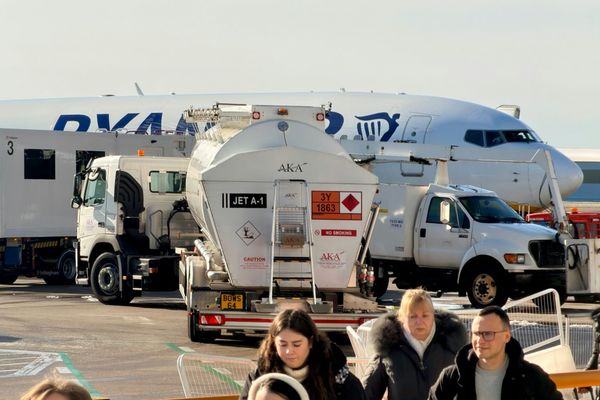
The consequences are already visible at ground level. Air BP Italia has rationed jet fuel at seven Italian airports, capping short-haul aircraft at 2,000 litres per uplift — less than one hour of flying time for a Boeing 737. Brindisi ran out entirely on 6 April. Frankfurt, Heathrow, Paris CDG, Lisbon, Copenhagen and Dublin have reported tighter conditions. Several EU member states hold strategic reserves of only eight to ten days before formal rationing would begin, according to reporting by Corriere della Sera.
The two-week ceasefire announced on 7 April has not meaningfully improved the supply picture. IATA has stated recovery will take months regardless of the political situation. An estimated 170 million barrels remain blocked in the Persian Gulf.
What makes the situation harder to manage than it needed to be is a combination of structural dependency and regulatory timing. The EU's new methane regulation, which comes into force in January 2027, is already deterring non-EU suppliers from signing summer delivery contracts — they do not want to enter obligations that may conflict with incoming compliance rules. Jankovec has asked the Commission to temporarily lift these import restrictions to incentivise alternative supply. That Brussels introduced a regulation whose side-effects include reducing fuel availability in a supply crisis is the kind of irony the Commission tends not to dwell on.
The carriers most exposed are those without hedging protection and those whose networks run through Italian and eastern Mediterranean airports. The carriers least exposed — Ryanair, hedged at 84% of current quarter requirements at $77 a barrel, and IAG, with meaningful North Atlantic and Iberian capacity that is less dependent on single-source fuel supply — have structural advantages built over years of risk management that look prescient rather than lucky in April 2026.
The Commission has been asked to map current and projected fuel availability against demand, identify alternative import sources, consider collective EU-wide fuel purchasing, and place specific obligations on refineries to safeguard jet fuel production. These are sensible requests. They are also requests that should not need to be made in the middle of a crisis — they should be standing policy in a bloc that imports the majority of its aviation fuel through a single geographic chokepoint.
Europe has spent three years renegotiating its energy dependency after Russia's invasion of Ukraine revealed the cost of structural reliance on a single supplier. It did not apply the same lesson to jet fuel. The summer flight schedule now depends on whether that oversight can be corrected in weeks rather than years.
It probably cannot.