Zero hedging, one pending acquisition, and the worst fuel crisis in fifty years
The Strait of Hormuz opened for twelve hours on Friday. By Saturday morning Iran had closed it again. For an unhedged carrier still in post-bankruptcy recovery, every additional week of this costs money it cannot spare.

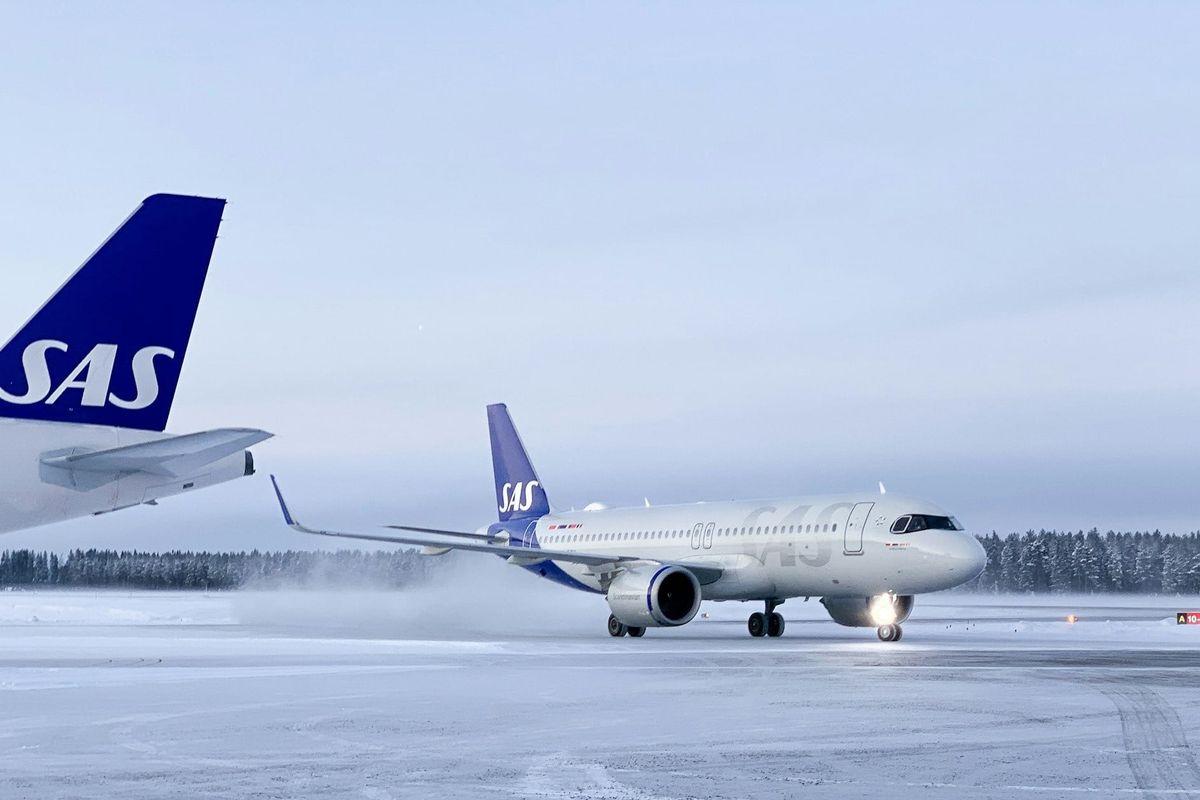
When Scandinavian Airlines adjusted its hedging policy in 2025, citing uncertain market conditions, the decision was framed as prudent flexibility. The carrier entered 2026 with zero per cent of its fuel consumption hedged — the only major European airline to do so. Seven weeks later, jet fuel prices doubled. The Strait of Hormuz opened briefly on Friday before Iran closed it again on Saturday after Iranian Revolutionary Guard gunboats fired on merchant vessels attempting to transit, with the IRGC declaring that no vessel should approach the strait until the US naval blockade of Iranian ports is lifted. For SAS, this is not a distant geopolitical development. It is the direct determinant of whether the airline survives the summer intact.
SAS cancelled at least 1,000 flights in April after jet fuel prices doubled within ten days, with rival Norwegian immediately ramping up capacity across the Scandinavian market in response. The cancellations were concentrated on thin-margin short-haul routes within Norway — domestic flying where surface transport is viable and yield is lowest. On top of the capacity cuts, SAS raised fares: European routes by approximately 500 kronor per ticket and transatlantic routes by approximately 2,700 kronor per ticket — roughly $290 — in an attempt to recover some of the fuel cost increase being absorbed at the operating level. The surcharges have not been enough. The flights still being operated on routes where demand exists but yields are structurally thin are costing the airline more to fly than it is recovering from passengers. That is the basis of the cash preservation logic behind the cancellations.
SAS is not a large airline. It operates approximately 800 flights per day; 1,200 cancellations across March and April represent a meaningful fraction of its spring schedule, and they came before the peak summer season on which the carrier's financial year depends most heavily. The question the fuel crisis has forced onto the table is whether the summer is recoverable, whether Air France-KLM's pending acquisition can survive the damage this quarter has done to SAS's financial position, and whether the strait's renewed closure makes that question harder to answer by the day.
A bankruptcy that left no margin for error
To understand why SAS's current position is so exposed requires understanding how little room the airline was operating with before 28 February.
SAS filed for Chapter 11 bankruptcy protection in July 2022, burdened by over $2 billion in debt from post-pandemic losses. It emerged in August 2024 with $1.2 billion in fresh investment from a consortium including Castlelake, Air France-KLM and the Danish state. The restructuring gave the airline a cleaner balance sheet, a renegotiated cost base and a strategic relationship with one of Europe's largest airline groups that appeared to secure its future. SAS had, by all appearances, used the near-death experience to rebuild a viable carrier.
What the restructuring did not provide was a financial cushion sufficient to withstand an unhedged commodity shock. The decision to enter 2026 with no fuel cover was made against a backdrop of falling crude prices and forecasts pointing toward a contained fuel environment. IATA's December 2025 outlook projected jet fuel averaging $88 per barrel in 2026, a modest decline from 2025 levels. That forecast was obsolete within weeks of being published.
The hedging decision almost certainly reflected financial constraints that accompanied the restructuring itself. Hedging programmes require upfront liquidity to post collateral and absorb mark-to-market movements as prices shift. A carrier emerging from bankruptcy with $1.2 billion in fresh investment and a network still being rebuilt may have concluded that the cost and liquidity requirements of a full hedging programme were not achievable given where the balance sheet stood. If that was the calculation, it was rational in 2025. It has become the central vulnerability in 2026.
The Air France-KLM complication
The fuel crisis has landed at the worst possible moment for the ownership question that was supposed to be settled by the end of this year.
Air France-KLM announced in July 2025 that it was initiating proceedings to take a majority stake in SAS, increasing its ownership from 19.9 per cent to 60.5 per cent. The transaction was expected to close in the second half of 2026, with the final valuation to be determined at closing based on SAS's financial performance including EBITDA and net debt.
That valuation clause is now doing significant work. The airline Air France-KLM agreed to acquire in the summer of 2025 — a restructured carrier with recovering load factors and a cleaned-up balance sheet — is not the airline that exists in April 2026. April is a month of crisis management for SAS, in which securing liquidity is the immediate operational priority. Every cancelled flight that generates a refund obligation rather than revenue, every route yielded to Norwegian, and every week of elevated unhedged fuel costs is reducing the EBITDA figure against which the closing valuation will be calculated.
Air France-KLM's CFO said the group expected to generate three-digit million euros in synergies from raising its SAS stake, with the transaction to be funded from cash or a plain vanilla bond without impacting the group's hybrid debt reduction programme. The group held €9.4 billion in cash at the end of June 2025 with leverage of 1.5 times — a position from which it can absorb a deal that has become considerably more complicated than it appeared when signed. The strategic rationale remains intact: a Northern European feeder network, 25 million passengers, 130 destinations and over eight million EuroBonus loyalty members.
EuroBonus will likely be replaced by Flying Blue once the Air France-KLM takeover is complete — a transition that would extend the group's loyalty reach deep into Scandinavia and integrate SAS's customer base into one of Europe's largest travel rewards programmes. That prize has not diminished. What has changed is the price at which it arrives, and the condition of the asset at closing.
The question Air France-KLM's board must now answer is whether to proceed on terms that reflect the fuel damage done in the first half of 2026, to renegotiate the valuation downward, or to delay closing until SAS's numbers recover sufficiently to support a more defensible price. None of these options is straightforward. A lower valuation hurts SAS's creditors and existing shareholders, including the Danish state. A delay extends the period during which SAS operates without the balance sheet support of full group ownership. A renegotiation requires both parties to agree that the crisis damage is temporary rather than structural — a judgement that depends almost entirely on how quickly the Hormuz situation resolves.
Signs of stress; not yet of collapse
The signals that would indicate a carrier approaching a second distress event are accelerating cash burn, creditor alarm, loss of access to credit markets, and management instability signalling a breakdown of board confidence. None of these is confirmed in the public record at this point. What is visible is a set of precursors that warrant close attention.
The 1,200 flight cancellations are a cash management decision before they are anything else. The airline is not cancelling flights because it lacks aircraft or crew; it is cancelling them because operating them at current unhedged fuel prices would drain cash faster than the revenue recovered from passengers. That is rational triage — and it is the same decision that airlines in previous fuel crises have made before they have been forced into more serious restructuring. Triage does not always prevent deterioration; it buys time.
Market share is shifting toward financially strong, well-capitalised carriers. Lufthansa, with 81 per cent of its 2026 fuel requirements hedged at pre-crisis rates, is using its cost advantage to consolidate its competitive position across European networks. Norwegian, entirely unencumbered by SAS's restructuring legacy and carrying no bankruptcy overhang, is adding capacity on the Scandinavian domestic and regional routes that SAS is pulling back from. Every passenger Norwegian acquires during this period is a passenger SAS must win back when the market normalises — and winning back passengers requires investment that a cash-constrained carrier cannot freely make.
The EuroBonus loyalty programme is the most durable asset SAS holds in the current environment. It has over eight million members and international reach through the SkyTeam alliance, which SAS joined in September 2024 after leaving Star Alliance as part of its restructuring and alignment with Air France-KLM. Loyalty revenue provides a floor below which SAS's income does not fall regardless of how many scheduled flights are cancelled; it also represents the clearest future source of value for Air France-KLM once the acquisition completes and the programme migrates toward Flying Blue. That floor matters in a quarter like this one.
What the strait's renewed closure means
Friday's brief Hormuz reopening briefly justified cautious optimism. Heating oil futures fell 13 per cent on the news; oil dropped to approximately $90 per barrel. By Saturday morning, Iran had reversed course entirely, with IRGC gunboats firing on merchant vessels in the strait and the Revolutionary Guard declaring that no ship should approach Hormuz until the US naval blockade of Iranian ports is completely lifted. The fuel market relief of Friday has been partially unwound.
For SAS specifically, the renewed closure extends precisely the environment that the airline is least equipped to absorb. Every additional week of unhedged fuel costs at spot prices — currently still roughly double pre-war levels despite Friday's brief retreat — is a week of cash outflow that the airline cannot recover. The summer season that should provide natural revenue relief, with fuller aircraft on Scandinavian leisure routes to Southern Europe and the North Atlantic, is now being planned against a fuel cost backdrop that has not stabilised.
Pakistan is expected to host a second round of US-Iran negotiations early next week. If those talks produce a durable agreement that includes US blockade relief and genuine strait reopening, the fuel forward curve will shift downward and SAS's summer economics begin to improve. If they do not, the airline faces a second consecutive quarter of elevated unhedged costs — and the Air France-KLM valuation at closing will reflect that.
The comparison that matters
PLAY Airlines, the Icelandic ultra-low-cost carrier, ceased operations completely in September 2025 after being unable to secure funding to weather persistent financial pressure, affecting over 1,750 travellers and 400 employees. SAS is not PLAY. It is a flag carrier with state shareholders, a pending acquisition from one of Europe's largest airline groups, a loyalty programme of genuine value, and a restructured cost base that is more resilient than anything PLAY ever built.
The comparison is not about equivalence. It is about the category of risk that unhedged fuel exposure creates for a carrier that has recently restructured and is operating without reserve capacity to absorb a sustained commodity shock. PLAY had no backer willing to support it. SAS has Air France-KLM waiting in the wings with €9.4 billion in cash and a clear strategic motivation to see the acquisition close.
The question is whether Air France-KLM's support is contingent on SAS remaining solvent and operationally credible through to closing — or whether it would extend to active intervention if the fuel crisis runs long enough to threaten the airline's liquidity before the transaction completes. That distinction has not yet been tested. The strait's renewed closure this morning means it may be.