Virgin Australia holds profit guidance as fuel hedge limits Middle East exposure
Virgin Australia has maintained its FY26 profit guidance after hedging 92% of Brent crude exposure limits the Middle East fuel shock to A$30–40m above prior forecasts — against a A$800m revision at Qantas.

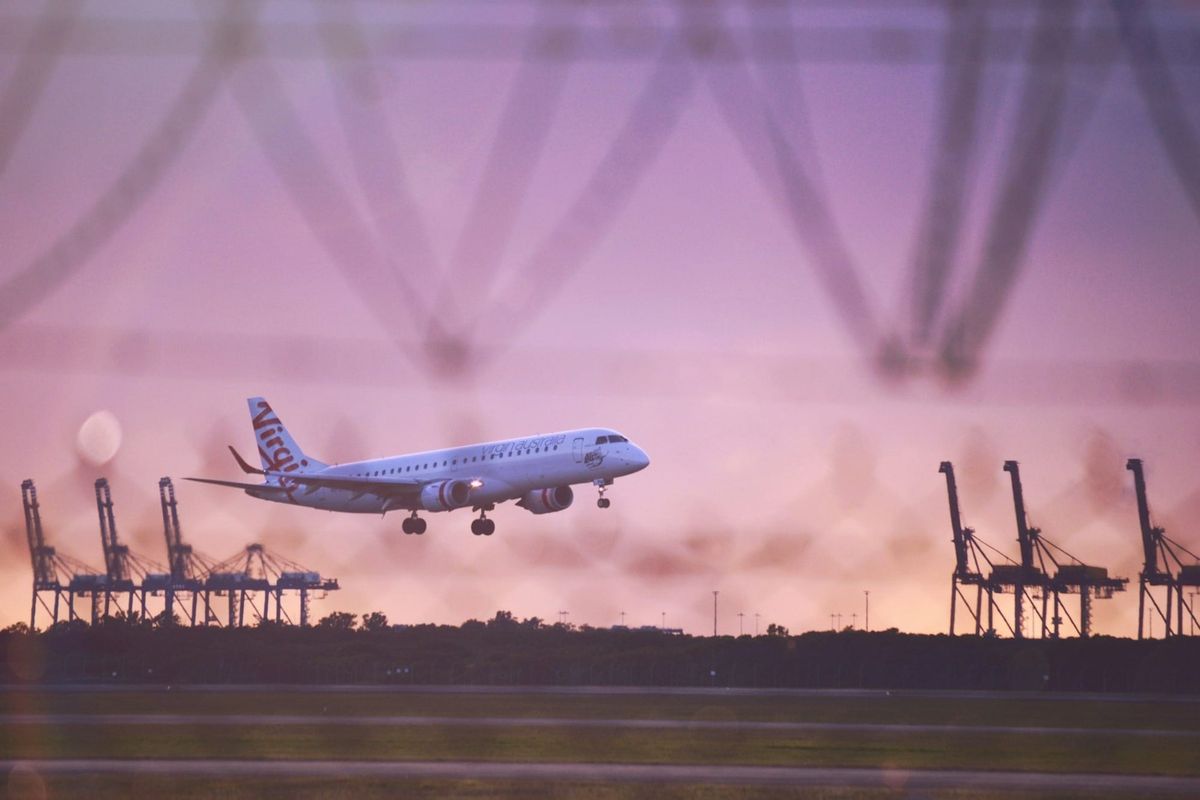
Virgin Australia told the ASX on Wednesday that its full-year earnings guidance remains intact despite jet fuel prices more than doubling since late February, as heavy hedging positions limit the airline's second-half cost exposure to between A$30 million and A$40 million above earlier forecasts.
The update, released to the stock exchange on 15 April, confirmed that underlying EBIT and EBIT margin for the second half of FY26 are still expected to improve on the same period last year. Shares rose as much as 12.3% to A$2.64 — their highest level since 19 March — before settling 5.5% higher, against a 0.2% rise in the S&P/ASX 200.
The contrast with Qantas — whose second-half fuel bill is rising by A$800 million to A$3.3 billion, partly reflecting its far larger international network — illustrates the relative insulation Virgin's hedge position provides on a domestic-focused operation. Virgin has hedged 92% of its Brent crude exposure for the remainder of FY26 and 71% of its refining margin exposure. Fuel represented A$554.7 million of total operating expenses in the first half of FY26 — 21% of the total, equivalent to 3.4 million barrels of oil consumed. At current spot prices, the unhedged portion of that exposure generates the A$30-40 million additional cost; no more.
Virgin Australia vs Qantas — H2 FY26
Fuel cost increase above prior guidance
Percentage increase vs H2 FY26 forecast at time of half-year results
Virgin prior guidance
~A$554m
H1 FY26 fuel spend
Qantas prior guidance
A$2.5bn
H2 FY26 forecast Feb 2026
Qantas revised guidance
A$3.1–3.3bn
+28% above forecast
Sources: Virgin Australia ASX release 15 April 2026; Qantas ASX release 14 April 2026 and H1 FY26 results February 2026. Virgin percentage calculated using H1 FY26 fuel expense of A$554.7m as proxy for H2 prior guidance. Qantas prior guidance A$2.5bn stated at H1 FY26 results.
For the second half, Virgin has revised its revenue per available seat kilometre guidance upward to approximately 5% growth — from a prior range of 3-4% — rising to 6% in the fourth quarter as fare increases take effect. Domestic capacity growth has been wound back to 1% for the half, with a 1% reduction anticipated in Q4 as the airline adjusts scheduling to protect yield. The company confirmed fuel supply assurance from its suppliers through to at least May, removing a near-term operational risk that had weighed on the stock.
The Doha services, operated under a wet lease with Qatar Airways, remain suspended until at least mid-June. Virgin said the financial impact of that suspension is minimal given the wet lease structure transfers operational risk to Qatar Airways rather than Virgin directly.
The results stand on the foundation of the first-half FY26 performance reported in February: underlying EBIT of A$490 million, up 11.7% year on year; underlying NPAT of A$279 million, up 21%; and net debt reduced to 0.9 times EBITDA. The transformation programme has delivered more than A$1 billion in cumulative benefits since FY24, with the H1 result representing A$200 million in gross benefits for the half alone.
The hedging position provides a clear near-term floor. The vulnerability lies further out. For the first half of FY27, Virgin has hedged 93% of Brent crude exposure — but refining margin coverage drops to 15%. The crack spread, which has risen from approximately $25 to above $100 per barrel since the conflict began, is the component most airlines underhedge and most investors underweight in their earnings models. If the Hormuz blockade declared by Trump on 13 April persists into the second half of calendar 2026, Virgin's FY27 exposure to the refining margin will become the number to watch.
Full-year FY26 results are scheduled for August 2026.