Alaska Airlines flies to Europe for the first time in its 93-year history as the Hawaiian merger delivers its intended purpose
Alaska Airlines flight AS180 departs Seattle for Rome tomorrow — the first transatlantic flight in the carrier's 93-year history. The Hawaiian Airlines merger gave Alaska the 787s to do it.

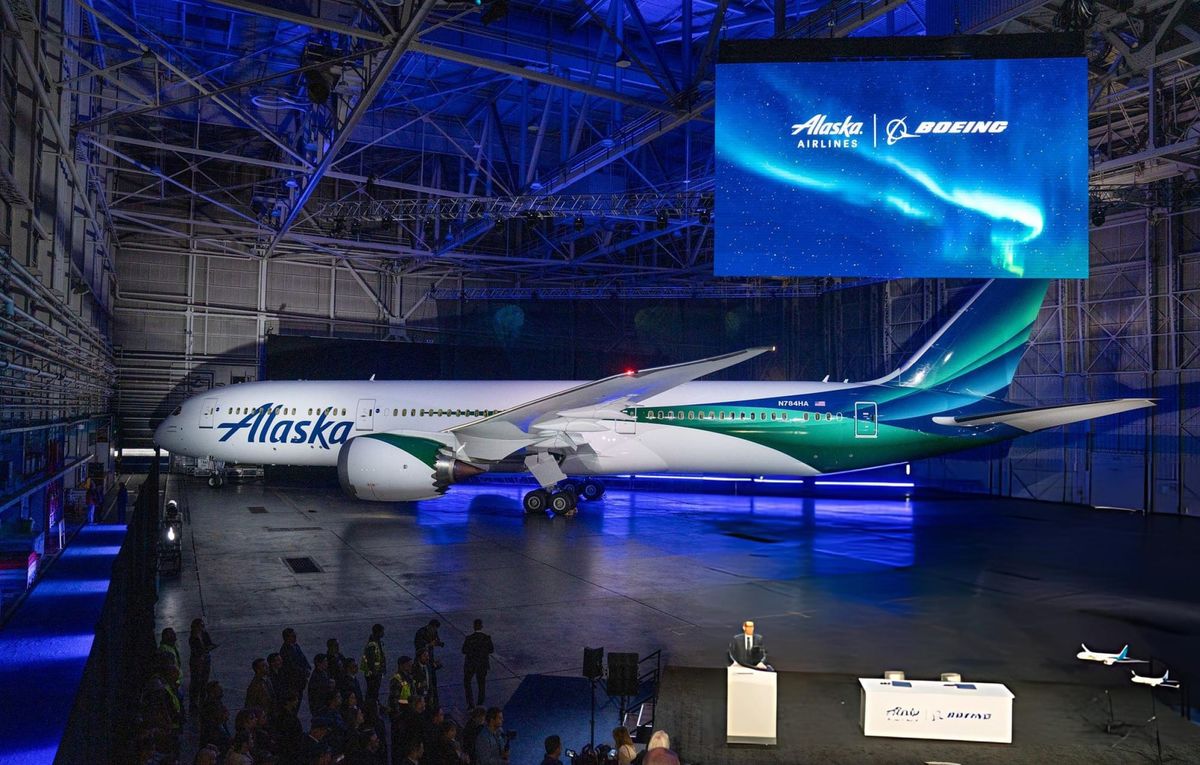
Alaska Airlines flight AS180 departs Seattle-Tacoma International Airport for Rome Fiumicino tomorrow at 5.30 pm (PDT), completing a journey that began not in the route planning department but in the boardroom in October 2024, when Alaska Air Group acquired Hawaiian Airlines for $1.9 billion. The acquisition gave Alaska something its 93 years of history had never produced: aircraft capable of transatlantic flight. Without that fleet, tomorrow's departure does not happen. With it, Alaska becomes a different kind of airline.
The Seattle to Rome service operates daily on a seasonal basis through 23 October, on a 300-seat 787-9 configured with 34 business class suites, 79 premium economy seats and 187 economy seats. The 5,688-mile route was originally planned at four weekly frequencies; strong advance bookings prompted Alaska to upgrade to daily before the first departure. London Heathrow follows on 21 May, operating year-round daily. Reykjavik opens on 28 May on a Boeing 737 MAX. Alaska's Alaska Accelerate plan targets at least 12 intercontinental destinations from Seattle by 2030, with up to 17 Boeing 787s deployed across the global network.
What the Hawaiian merger was for
The acquisition of Hawaiian Airlines was presented publicly as a Pacific expansion. The operational logic was more specific. Hawaiian had what Alaska lacked: widebody aircraft, long-haul crew certification, international operational infrastructure and four Boeing 787-9s already delivered against an order for twelve more. Alaska had what Hawaiian lacked: a dominant West Coast domestic network, a oneworld alliance membership that provides connectivity to British Airways, American Airlines, Cathay Pacific and Qantas across 1,000 destinations, and a Seattle hub that its own analysis identified as having a 10 per cent distance advantage over Los Angeles and San Francisco on routes to Europe.
The combined proposition, Hawaiian's widebody capability plugged into Alaska's Seattle hub and oneworld network, is the infrastructure behind tomorrow's departure. Neither carrier could have launched Seattle-Rome independently. Together, the logic is coherent. The test is whether the revenue justifies the $1.9 billion acquisition cost and the complexity of integrating two carriers with different cultures, fleets and route structures.
The competitive response
The clearest external validation of Alaska's Seattle hub strategy arrives eight days after tomorrow's inaugural: Delta Air Lines launches its own Seattle to Rome service on 6 May, four times weekly on an Airbus A330-900neo. Delta does not match routes it does not expect to be commercially significant. Its decision to respond to Alaska's Rome launch within days of the announcement confirms that the Pacific Northwest-to-Europe market is significant, demand exists to support more than one carrier, and that Delta considers Alaska's move a competitive threat to its existing Seattle international franchise rather than a niche play that can be ignored.
Alaska launched introductory economy fares from $599 roundtrip on Seattle to Rome; Delta's pre-announcement pricing on comparable Seattle-Europe itineraries ran to $1,200 and above. A duopoly on Pacific Northwest transatlantic routes had produced fares that reflected the absence of competition. Alaska's entry into the market is not primarily a route launch; it is a pricing event for every traveller in the Pacific Northwest who has been paying Delta and United's unchallenged transatlantic rates for years.
What Seattle now is
The route map Alaska is building out of Seattle — Rome, London, Tokyo, Seoul, Reykjavik and twelve intercontinental destinations by 2030 — is a deliberate reimagining of what the city's airport can become. Alaska describes Seattle as the largest airline hub on the West Coast, serving 109 nonstop destinations across its network. That claim has been historically difficult to sustain against the volume of Los Angeles International and San Francisco International, which anchor Delta's and United's West Coast international operations. The difference is geography: Seattle's position at the top of the Pacific Northwest puts it closer to Europe via the polar routing and closer to Northeast Asia than any other major West Coast hub. Alaska is building a hub strategy around a geographic advantage the airline could not previously exploit because it had no widebody aircraft.
Whether that strategy produces the $1 billion in incremental profit that the Alaska Accelerate plan targets from the Hawaiian combination is a question that the Rome inaugural, the London launch and the twelve-destination target will need to answer over the next four years. Tomorrow's 5.30 pm departure is the first data point in that answer.