Wizz Air's profit falls by two-thirds as fuel costs rise 34%
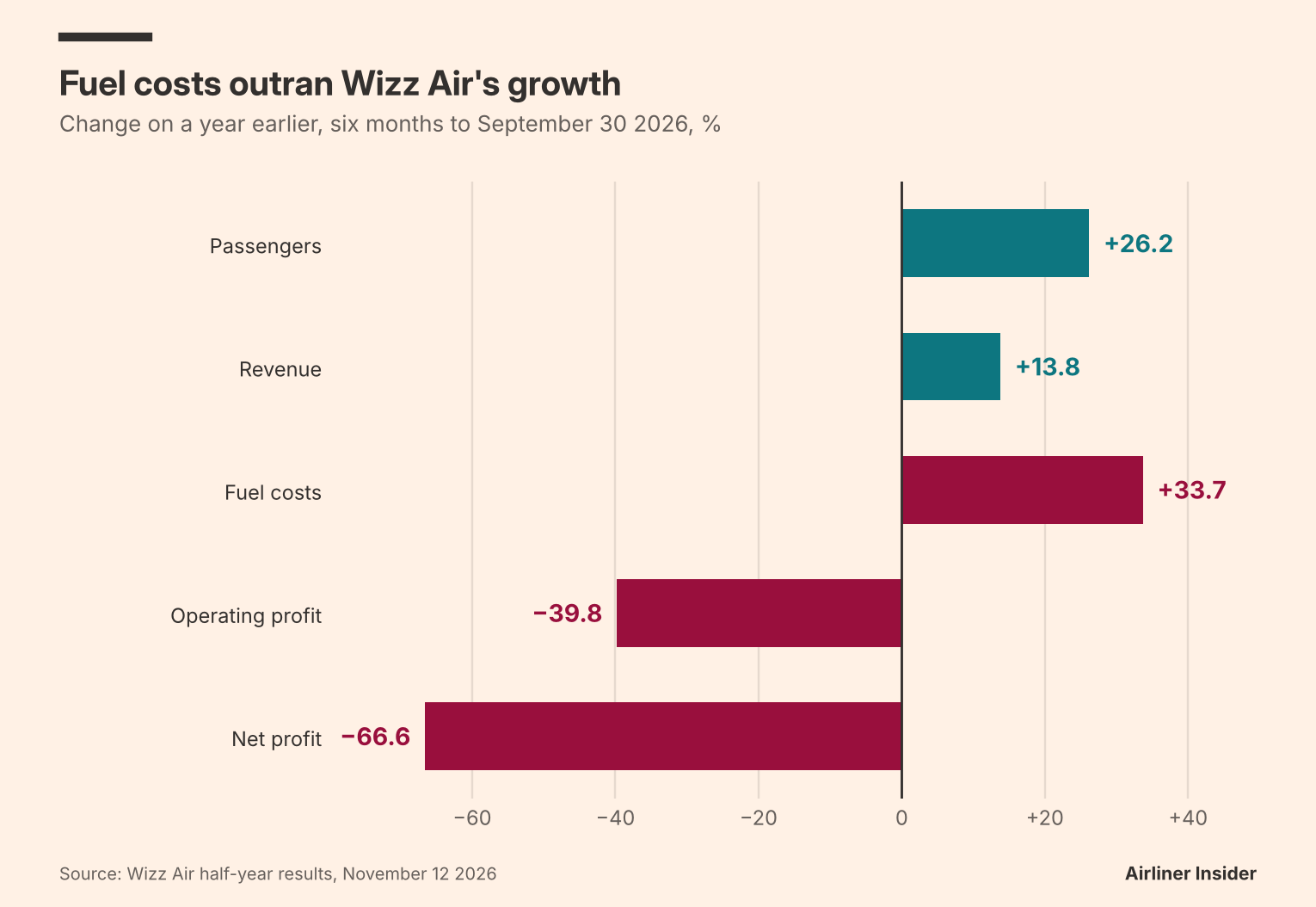
Wizz Air's first-half net profit fell 66.6 per cent to €108.1mn as fuel costs rose 33.7 per cent, despite 26 per cent more passengers. The airline is cutting winter flying, has hedged half of summer 2027 and says fares are rising.


Wizz Air's net profit fell 66.6 per cent to €108.1mn in the six months to September 30, from €323.5mn a year earlier, as fuel costs rose 33.7 per cent to €1.24bn and outpaced revenue growth of 13.8 per cent to €3.80bn. Operating profit fell 39.8 per cent to €264.5mn in the results published on November 12, even though passenger numbers rose 26.2 per cent to 46.1mn.
The half split sharply between its two quarters, with a net loss of €198mn in the three months to June, when higher fuel costs and disruption in the Middle East weighed on results, followed by net profit up 7.4 per cent to €306.3mn in the three months to September. Chief executive József Váradi called it "really a tale of two quarters".
Growth came at the expense of price, as average revenue per passenger fell 9.9 per cent to €82.50 and revenue per available seat kilometre, the industry's measure of unit revenue, fell 2.9 per cent while unit costs rose 4.3 per cent. The airline filled 92.5 per cent of its seats, against 92.4 per cent a year earlier.
Fuel remains the main risk for the second half, after Wizz Air paid an average of $176 a tonne more than a year earlier once hedging is included. It has hedged 82 per cent of its fuel for the six months to March with a cap of $860 a tonne, and 51 per cent of its needs for summer 2027, a higher share than Ryanair's 25 per cent for the year from April 2027.
Costs other than fuel are also rising, and the airline expects unit costs excluding fuel to increase by a mid-single-digit percentage this financial year as it retires older Airbus A320ceo aircraft. Váradi told Reuters that phasing out those jets would add more than €100mn of costs in the second half, while 22 aircraft remained grounded at the end of September for inspections of their Pratt & Whitney engines, down from 35 a year earlier.
Wizz Air has responded by flying less than it planned this winter, cutting capacity by about 6 per cent against its original schedule and offering buyouts to some pilots at London Luton, its main UK base. Seat capacity will still rise by about 19 per cent in the three months to December, with Spain among its fastest-growing markets.
The airline expects the higher fuel bill to reach passengers, and Váradi said that "the fuel price environment will dictate how much fares will go up". Unit revenue rose about 5 per cent in October and ticket revenue per passenger 7 per cent, and Wizz Air forecasts a low-single-digit increase in unit revenue for the three months to December, having sold about 70 per cent of its November seats and 40 per cent of December's.
Wizz Air gave no forecast for full-year profit, citing fuel prices and uncertainty in the Middle East, where it resumed flights to Tel Aviv in late May but has postponed a return to Abu Dhabi and Dubai because airspace restrictions force longer and more expensive routings.
Liquidity improved over the half, with cash rising to €2.39bn from €2.13bn at the end of March, although net debt also rose to €5.16bn from €4.94bn. Shares fell as much as 4.4 per cent in early trading in London on November 12, leaving them 11 per cent lower this year.
What to watch: fares through the winter as capacity growth slows, the cost of retiring the A320ceo fleet, how much more of summer 2027 Wizz Air hedges, and whether the airline returns to the Gulf before its full-year results.