European air fares set for 10–15% rise next summer
Europe's largest airlines raised their 2027 fuel hedges in November at prices well above this year's, while cutting flights and chasing their most profitable routes. We expect fares to rise by around 10–15 per cent next summer, a smaller and later version of the US jump.


€1 = $1.0975
Europe's largest airlines used their November results to close much of the gap in their fuel protection for 2027, although the new cover costs far more than the hedges that carried them through this year. Combined with cuts to flying and a shift towards their most profitable routes, that leaves passengers facing higher fares next summer, and we expect European ticket prices to rise by around 10–15 per cent.
Hedging allows an airline to fix the price of part of its fuel months in advance, which protects it when market prices jump but locks it into the agreed price if they fall. European airlines bought much of this year's cover before the war in the Middle East began in late February, which is why they have paid far less for fuel in 2026 than the market rate.
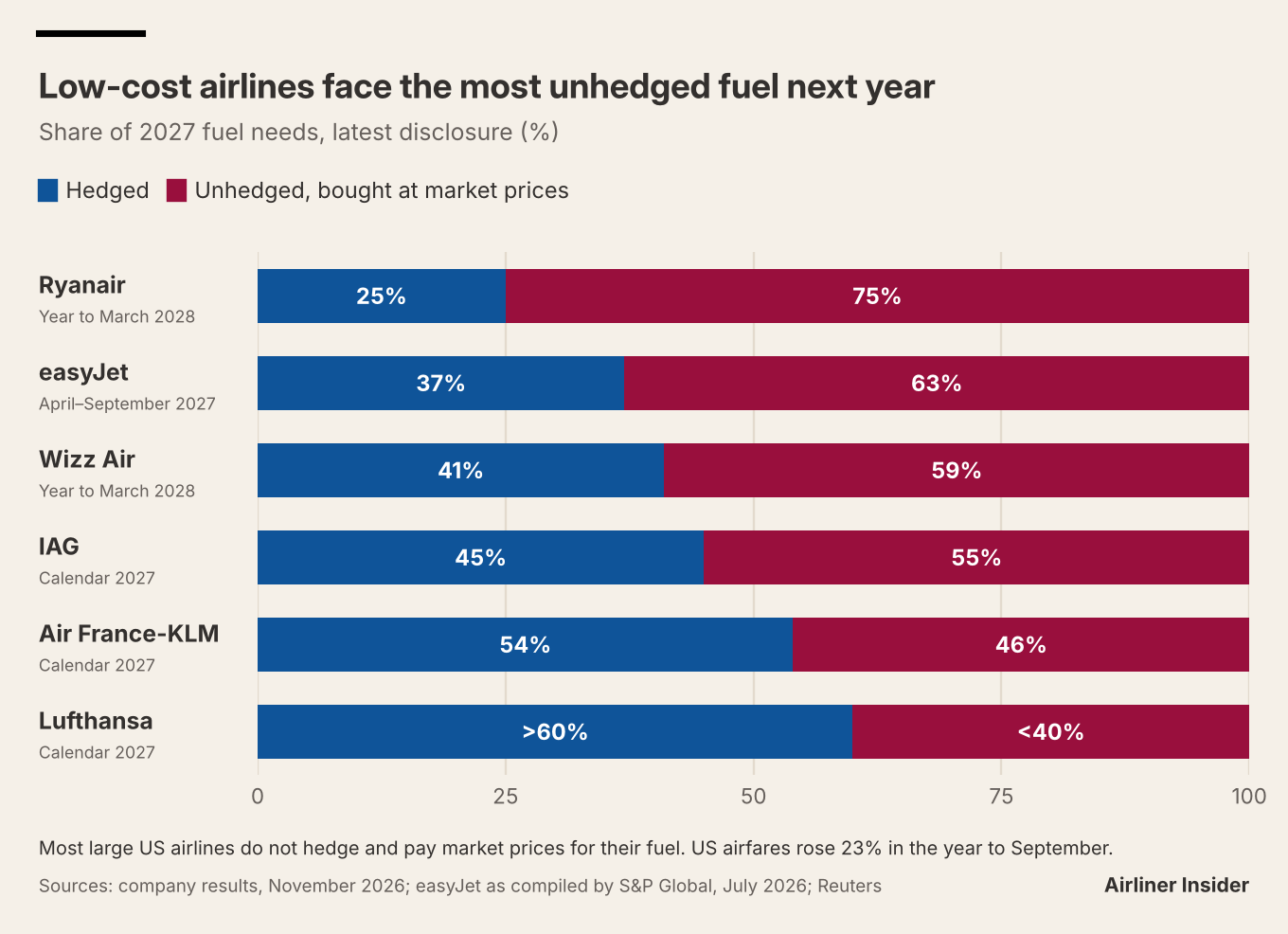
Ryanair shows how that cushion is thinning, having fixed 25 per cent of its fuel for the year to March 2028 at about $95 a barrel, against 80 per cent at about $67 for the current year. Its hedged price has risen by roughly 40 per cent, and three-quarters of its fuel for next year is not yet hedged.
A month ago the industry looked set to enter April 2027 largely unprotected, when we reported that Ryanair had hedged 15 per cent of the following year and Wizz Air 23 per cent. Wizz Air now has 41 per cent of next year's fuel capped at $1,009 a tonne, against a cap of $819 a tonne for this year.
The network groups have moved furthest, with Air France-KLM reporting on November 5 that it had hedged 54 per cent of its 2027 fuel, up from about 40 per cent at the end of July. Lufthansa has covered more than 60 per cent of next year, while IAG, the owner of British Airways, is 45 per cent hedged for 2027 and has covered half of the second quarter, against 31 per cent in July.
Market prices have eased since our October analysis, with the global average jet fuel price falling 14 per cent to $169.82 a barrel in the week to November 13, from $196.70 in the week to October 23, according to the International Air Transport Association's fuel monitor. The fall came from cheaper crude rather than easier supply, since the premium of jet fuel over crude oil rose to $77.18 a barrel from $75.77.
The new hedges protect airlines against another spike, which industry panellists warned this month could come in 2027 as inventories run low, although they do much less to reduce the bill because their prices were set during the war. Lufthansa expects its fuel bill for 2026 to reach €9.3bn, about €2bn more than in 2025, and its chief financial officer, Till Streichert, has warned that next year's bill will be higher still "despite our comparatively strong hedge position".
Airlines facing bills of that size have three ways to respond, and Europe's carriers are now using all of them at once: flying less, concentrating on their most profitable routes and charging more. Ryanair, which estimates that its fuel bill could rise by about €2bn in the year to March 2028, cut about 2mn seats from its winter schedule in September and lowered its passenger target for the year from 216mn to 214mn.
Ryanair expects the cut to reduce its winter losses by €70mn–€100mn, because the November to March season loses money even in normal years and every extra winter flight adds to its unhedged fuel bill. Lufthansa has cut 20,000 short-haul flights and grounded 27 aircraft from its CityLine subsidiary, while Volotea has cancelled 10 per cent of its winter flights and easyJet has removed or suspended dozens of winter routes.
The network groups are holding back as well, with IAG expecting to fly slightly less this year than last, its first reduction since 2022, and Air France-KLM cutting its forecast for capacity growth to about 2 per cent. KLM announced in November that it would cut 1,000 jobs and change its European fleet as part of a wider restructuring.
The flying that remains is being steered towards long-haul routes and premium cabins, where passengers are less sensitive to price and fares have risen fastest. Lufthansa added capacity mainly on long-haul routes in the third quarter, when average yields at its network airlines rose 7 per cent on demand for premium seats and for flights to Asia and North America, while IAG's unit revenue on the North Atlantic rose 11 per cent.
Wizz Air is the exception, having increased its seat capacity by 26 per cent in the six months to September, which leaves it carrying faster growth than its rivals into a year of rising costs.
Prices are the third lever, and Air France-KLM and Lufthansa have both raised fuel surcharges, the separate charge added to the base fare, to recover part of the higher cost. Lufthansa expects double-digit increases in ticket prices in 2027 as its cheaper hedges expire, and Michael O'Leary of Ryanair said fares would need to rise by about 20 per cent in the year to March 2028 to cover the extra cost, while adding that he was unsure the airline could achieve it.
Ryanair's fares have already started to recover, with O'Leary saying third-quarter fares are trending modestly ahead of last year after a 4 per cent fall in the first half. Those bookings still benefit from this year's cheap hedges, so the real test comes when summer 2027 flights are priced against a fuel bill that is three-quarters unhedged.
The United States shows both the scale of the increase and its limits, because most of its large airlines do not hedge and have paid market prices since the conflict began. Airfares there rose 23 per cent in the year to September, against overall inflation of 3.6 per cent, and passenger revenue at Delta, United, American, Southwest and Alaska rose 18 per cent on traffic growth of less than 1 per cent, according to a Reuters analysis.
Even increases on that scale have not covered the bill, with United recovering only 72 per cent of its higher fuel cost in the third quarter and American now expecting a loss for the year. Europe will feel a smaller and later version of that shock, since its airlines enter next summer with hedge ratios from 25 per cent at Ryanair to more than 60 per cent at Lufthansa.
We expect average European fares next summer to rise by around 10–15 per cent, short of O'Leary's 20 per cent, with the sharpest increases at low-cost carriers, whose fuel is least hedged and makes up a larger share of their costs. The lower end becomes more likely if the premium of jet fuel over crude falls as S&P Global forecasts, from $74 a barrel in the fourth quarter to $40 by the second quarter of 2027.
For passengers, the practical effect is fewer flights this winter on marginal routes, particularly from smaller airports, and higher prices next summer on short-haul leisure routes where low-cost carriers dominate. Long-haul and premium fares have already risen, so the largest remaining increases are likely at the cheaper end of the market, where fares have so far lagged the cost of fuel.
What to watch: easyJet's full-year results, which will show whether it has followed its rivals after covering 37 per cent of April to September 2027 at $754–$777 a tonne, and Wizz Air's third-quarter results in January.